
WTO Chairs Programme highlights research and practical trade solutions at Aid for Trade Global Review
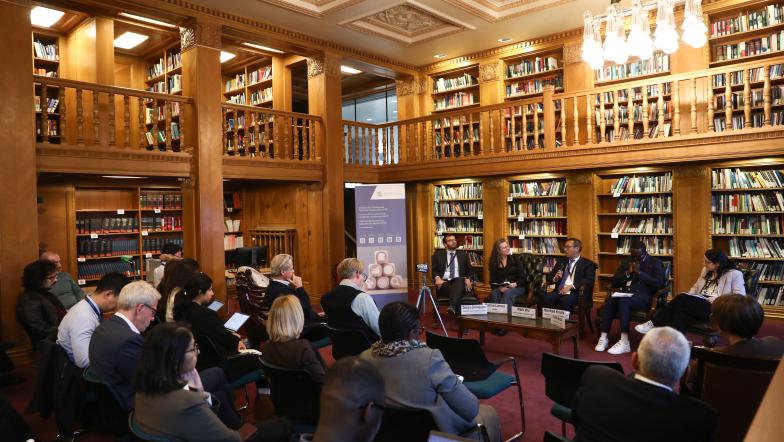
The WTO Chairs Programme (WCP) showcased the contribution of academic research to trade policymaking and practical trade solutions during the 10th Global Review of Aid for Trade, held on 29–30 October 2026 at WTO headquarters in Geneva. Through a dedicated policy dialogue and participation in the Trade Solutions Clinic, the programme highlighted concrete examples of how academic expertise is informing trade policy and addressing emerging trade challenges.
The dedicated session, "Linking Academia to Policymakers in Developing Economies," held on 30 October, brought together representatives of WTO Chairs from Cameroon, Qatar and Chile, alongside Obreal, a WCP partner. Organized by the programme's donors, Austria, France and the Republic of Korea, in partnership with Obreal, the discussion was moderated by Mark Wu, President of the WCP Academic Advisory Board.
Representing the Asian network, Georgios Dimitropoulos from Hamad Bin Khalifa University in Qatar elaborated on several forms of engagement between Chairs and governments. These included training for trade officials in Qatar, technical advice on trade legislation in Chinese Taipei, and Vietnam's regular exchanges bringing together academia, government and industry. He also highlighted the contribution of India's Chair, whose Centre for Trade and Investment Law provides legal expertise to the government on trade negotiations and related policy matters.
Sofia Boza from Universidad de Chile, representing the Latin American and Caribbean network, illustrated how Chairs in the region contribute directly to policymaking. In Costa Rica, the Chair advises a parliamentary committee on trade-related legislation, while Brazil's Chair provides specialized training and technical reports for government officials. She also highlighted initiatives in Mexico to strengthen the capacity of trade negotiators to integrate gender considerations into trade agreements.
Representing Africa, Manfred Kouty from Université de Yaoundé II in Cameroon highlighted collaborative research on the implementation of the African Continental Free Trade Area (AfCFTA), including a jointly developed book examining implementation challenges and policy recommendations. He also discussed the international academic conference held ahead of the WTO's 14th Ministerial Conference (MC14), which generated policy recommendations on issues relevant to the negotiations. Other examples included postgraduate programmes in Cameroon and Benin that strengthen the trade policy expertise of public officials.
The discussion also underscored the importance of partnerships in sustaining Chairs' activities beyond initial WCP funding. Marina Larrea from Obreal outlined elements of Obreal's collaboration with the African Chairs, including support for the pre-MC14 conference and plans for a multilingual online training programme for senior officials in African ministries of trade and finance, in partnership with the Pan-African University.
From research to practical trade solutions
The WCP's visibility extended to the Trade Solutions Clinic on 29 October, where representatives from WTO Chairs in China (Shanghai) and Nigeria presented work addressing practical trade challenges.
Yue Jiang and Siqi Lu, from the Shanghai University of International Business and Economics, highlighted their research on cross-border data flows, emphasizing the importance of regulatory interoperability and policy coordination in facilitating digital trade.
Ngozi Egbuna from Nnamdi Azikiwe University in Nigeria introduced Zamani Africa, an emerging initiative aimed at helping businesses translate market access opportunities into completed trade transactions. Currently being piloted in Nigeria, the initiative seeks to address challenges relating to trust, verification, contracting and transaction coordination, including through structured exchanges of goods, while complementing existing financial and payment systems.
Together, these activities demonstrated the WCP's contribution to evidence-based policymaking and its potential to connect academic research with practical solutions to trade and development challenges.


